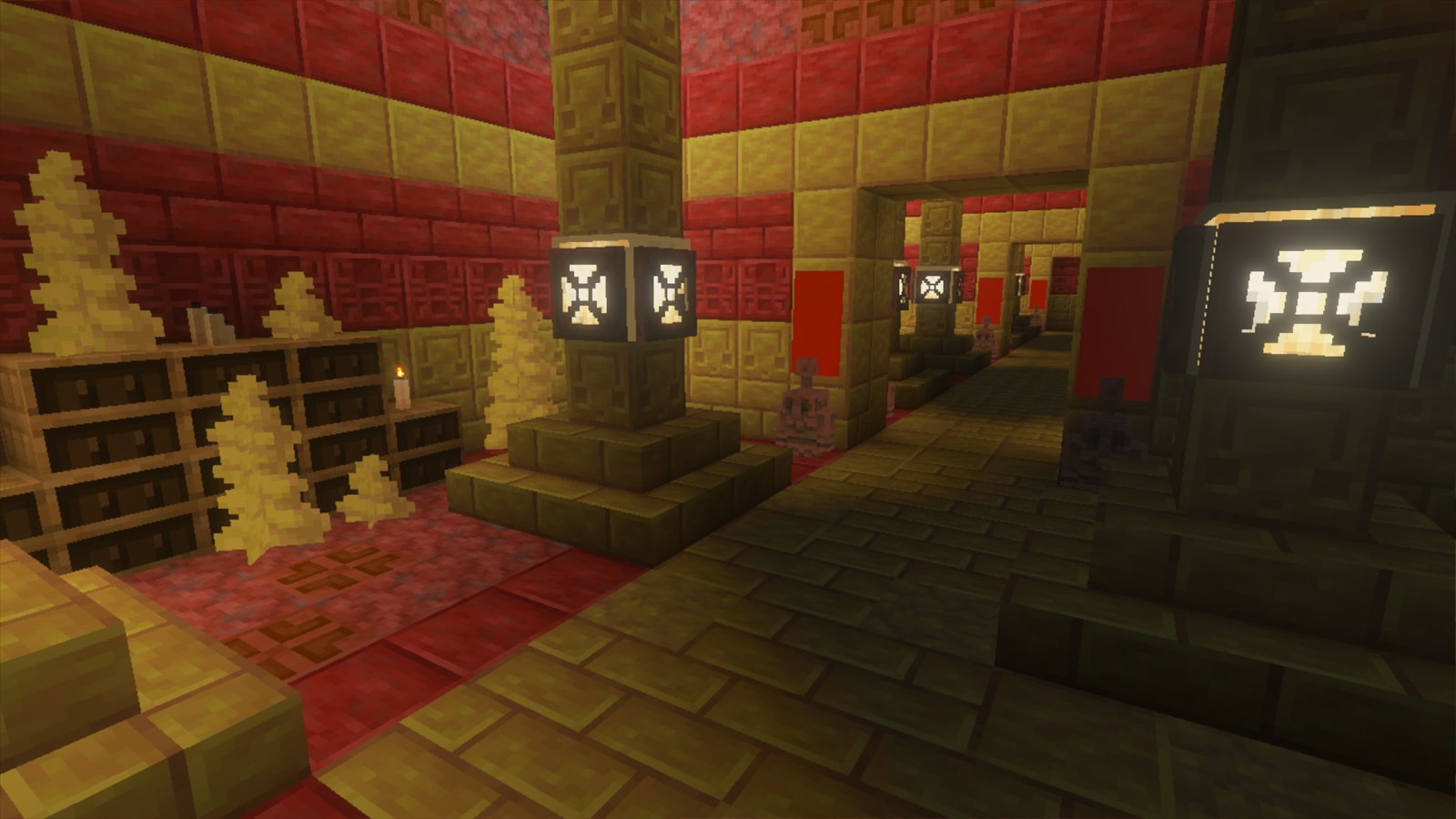
One download, four packs. They install together because they’re built to work together — and because Sulfur Dungeons genuinely cannot run without the Core layer underneath it.
Open any of the three below to read what it does. LLS Core rides along underneath — it’s the shared dungeon layer, with no content of its own.
 MagicNine elemental items across three tiers, and the weaving combinations between them.
What it is
Vanilla Minecraft has exactly one ranged attack that matters, and it’s a bow. Potions are consumables, enchantments are passive, and nothing in the game asks you to aim a spell and then live with the cooldown.
LLS Magic adds nine items built around that idea: three elements — fire, frost and shock — each in three tiers. A wand you snap-cast, a staff you channel, and a tome you hold in your offhand to ward everyone standing near you.
The three tiers
Wands are the fast option. Right-click and the spell leaves your hand in a quarter of a second, on a one-second cooldown. Small damage, a status effect, and you’re already casting again. 100 durability.
Staffs are the committed option — a 0.8-second channel with an animation that plays out before anything fires, then a 1.5-second recovery. What you get for the wait is a heavier payload: more direct damage, a 3-block splash that knocks everything nearby off its feet, and terrain that reacts. A fire staff eruption cracks open a couple of blocks and leaves small fires; a shock staff calls a real lightning bolt from up to 32 blocks away and chains it through six more targets. 180 durability.
Tomes aren’t weapons at all. Hold one in your offhand and sneak to channel a 1.2-second rite that wards every player within 12 blocks for 45 seconds. 60 durability.
| Tome | Ward | Also grants |
|---|---|---|
| Tome of Fire | Emberward | Fire resistance |
| Tome of Frost | Frostward | Water breathing |
| Tome of Shock | Stormward | Slow falling and swiftness |
All three additionally empower your elemental damage for the duration, so a tome is worth casting before a fight even when you don’t need the utility.
Spell weaving
This is the part that isn’t just “three flavours of the same wand”. Every hit leaves a mark on its target, and landing a second element on a marked target does something the first one couldn’t.
- Fireshock — shock something that’s already burning, and lightning chains outward to the four nearest mobs, setting each of them alight too.
- Frostshock — shock something that’s chilled and it flash-freezes solid for two seconds: near-total slowness, mining fatigue, weakness.
- Frostfire — hit a burning target with frost and the remaining burn detonates instead of being wasted. The longer it had left, the bigger the hit.
Each one throws a named callout on your action bar the moment it triggers, so you learn the combinations by playing rather than by reading this page. They work across players, too — one person burns, another shocks.
Crafting
Everything is shapeless at a crafting table, and everything starts from a stick.
| Item | Recipe |
|---|---|
| Fire Wand | stick + coal |
| Frost Wand | stick + packed ice |
| Shock Wand | stick + gold ingot |
| Fire Staff | Fire Wand + blaze rod + coal |
| Frost Staff | Frost Wand + blaze rod + packed ice |
| Shock Staff | Shock Wand + blaze rod + gold ingot |
| Tome of Fire | book + blaze rod + blaze powder |
| Tome of Frost | book + packed ice + prismarine shard |
| Tome of Shock | book + gold ingot + redstone |
The upgrade path is deliberate: a staff consumes its wand, so you’re choosing between snap-casting and channelling rather than carrying both.
Spells run out
None of this is free. Every cast spends durability, and a depleted wand tells you so on the action bar instead of silently doing nothing. Repairing is a shapeless recipe with the item’s own reagent — coal for anything fire, packed ice for frost, gold for shock, and blaze powder, prismarine shard or redstone for the tomes.
So a magic loadout is a supply line. Running a long dungeon on staffs means bringing blaze rods.
Version 1.1.0, released and playable — all nine items, the weaving combinations, and the ward effects are in and working. Previously called “LLS Magic Wands”, which stopped being accurate around the time it grew staffs and tomes.
 Magic CompanionsA snail that lives on walls and rides like a mount, and a floating eye in sixteen colours.
What it is
Minecraft’s tameable mobs mostly do one thing: they follow you. A wolf follows you and bites what you bite. A cat follows you and sits on your chest. Once you’ve tamed one, the interesting part is over.
LLS Magic Companions is two creatures built the other way round — the taming is where they start being interesting. The same world as Magic, minus the combat.
The Magic Snail
The snail is not a pet that trails behind you. Left alone, it goes and finds a wall.
About four out of five snails are wall-lovers. That’s a coin flip rolled once, the first time a snail thinks, and then remembered on that snail forever — so the one in your base is the one that lives on the north wall, not a random mob doing a random thing this minute. A wall-loving snail scans for a face at least two blocks tall, shuffles over to its base, crawls up to a height it picks for itself, and clings there for one to five minutes, scooting slowly sideways, occasionally drifting back down a little, before easing to the ground and choosing somewhere new.
The other one in five are floor snails. They read the light around them and shuffle toward the darkest spot they can find — under an overhang, into a roofed corner, behind something. Left running overnight, a group of snails quietly sorts itself into the walls and the shadows of wherever you put them.
Taming and riding
Snails are tamed with brown or red mushrooms — about a 40% chance per mushroom, and the same mushrooms heal them afterwards. Offer one to a snail that’s currently up a wall and it drops down to come and get it, so a wall snail is never out of reach.
A tamed snail takes a saddle and can be ridden. It has 30 health, falls slowly enough that it shrugs off most of the drop, and steps up ledges a block and a half high without needing a jump — it just flows over terrain that would stop a horse. It’s slow. That is the trade.
Two things make up for the speed:
- A dash. Three-second cooldown, and a genuinely violent lunge forward.
- Walls. This is the whole point of the mount.
Riding up a wall
Ride a snail into a wall and it latches. From there you drive it in two dimensions: W climbs, S descends, A and D sidle along the face, and sneak drops you off.
While you’re latched, the snail’s facing locks to the wall, so swinging the camera around to look at the view can’t break the grip, and you’re posed sideways on its back rather than sitting bolt upright in mid-air. It’s a mount that treats a cliff, a ravine wall or the side of your own build as ground.
Yongle’s Eye
The other companion is a single floating eye on a length of optic nerve. It bobs in place, drifts off to look around when nothing is happening, and takes no fall damage — it doesn’t land, so there’s nothing to land badly.
It’s tamed with an Ender Eye, about a one-in-three chance per eye, and the same item heals it. Taming doubles its health from 10 to 20 and turns on following — it keeps within a couple of blocks of you and re-closes the gap once you’re ten blocks out.
Sixteen irises
A tamed eye can be dyed, and the dye goes into the iris rather than over the whole model. All sixteen Minecraft dyes work, plus an ink sac for black, and the change is permanent and per-eye — it’s stored as an entity property, so it survives reloads and every eye in a group can be a different colour.
They’re also nameable and leashable, which between them is enough to keep a specific one somewhere specific.
Version 1.0.0. Both companions are built and working — the models, animations, taming, dyeing, saddle, dash and wall-riding are all in. What it hasn’t had yet is the long tail: sounds, spawn rules so they turn up without a spawn egg, and the tuning pass that comes from other people playing it.
The snail’s idle brains run on the scripting API rather than vanilla AI goals, which is the only way to get “find a wall and live on it for four minutes” out of Bedrock at all. They’re deliberately paced — one snail is considered per dimension per pass — so a large herd doesn’t trip the script watchdog.
 Sulfur DungeonsHand-built dungeons in the sulfur caves, guarded by statues that are not.
What it is
Minecraft generates caves, but it doesn’t build anything in them. A cave system is terrain — impressive terrain, and endless, but every chamber in it is the output of a noise function. Nothing down there was placed by someone who wanted you to walk into it.
The sulfur caves coming in the next update are the most distinctive underground space Bedrock has had in years, and they arrive the same way: empty.
LLS Sulfur Dungeons fills them. Hand-built dungeons that generate inside the sulfur caves, made out of the update’s own new blocks and built around its new mechanics rather than working past them.
Built on an unreleased update
This is the honest caveat, so it’s near the top rather than buried: the sulfur content isn’t in a stable Minecraft release yet. Everything here is being built against it early.
That has an obvious consequence — if Mojang renames a block, retunes a mechanic, or moves the caves’ generation, parts of this get rebuilt. That’s the trade for having dungeons ready on day one instead of six months after.
This is also why the rest of the pack is worth having on its own. Magic and the Companions run on Minecraft 1.21.0 today; the dungeons switch on when the sulfur update lands.
How it works
TODO — the generation rules. Worth answering here: how often do they appear, how deep, what stops two overlapping, and what’s actually inside one.
The hoggoyles
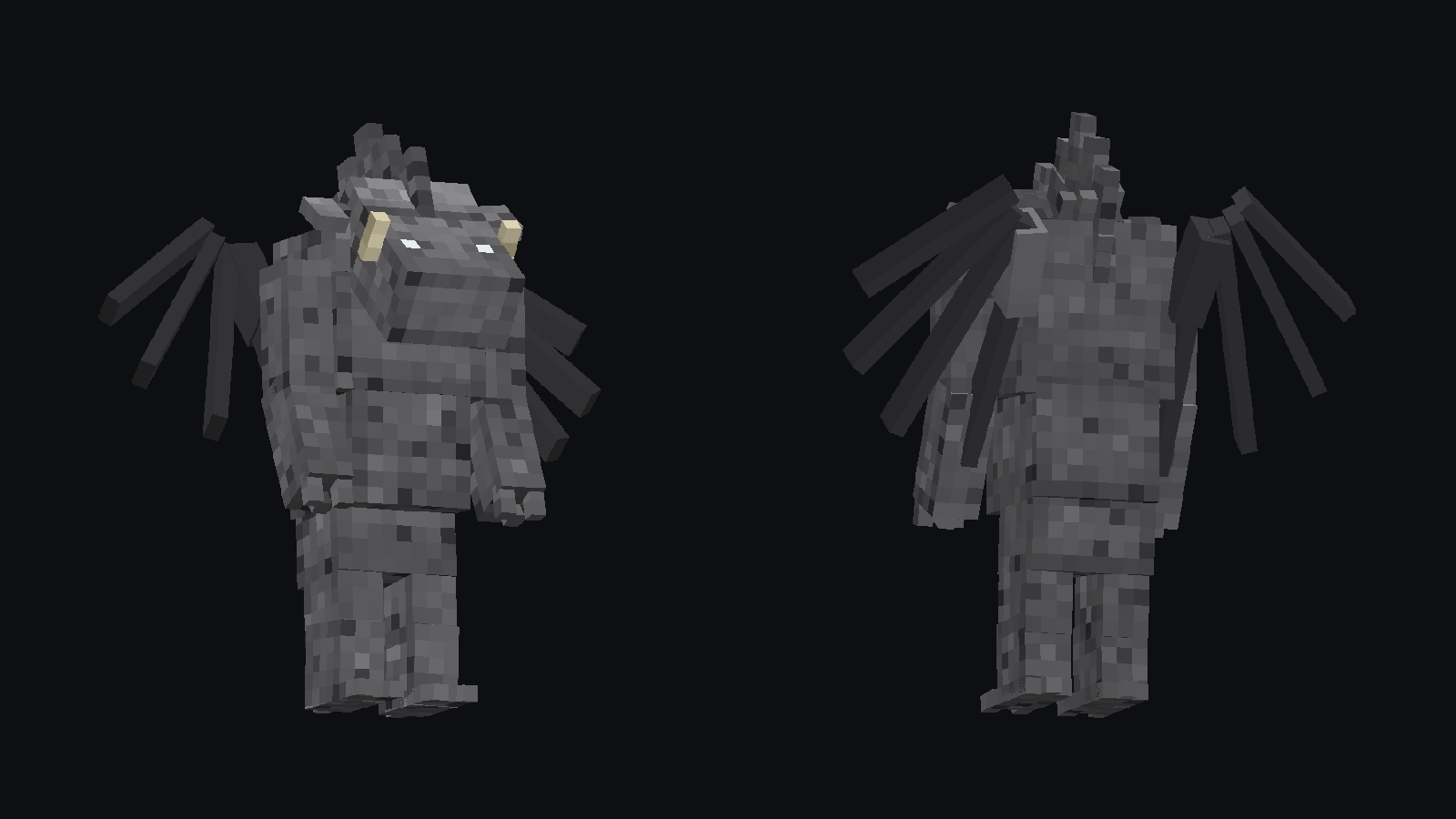
A dungeon needs something living in it, and the thing living in these is a statue that isn’t one.
Hoggoyles stand perfectly still — no movement, immovable, indistinguishable from the architecture, because that’s exactly what they’re pretending to be. Walk within about three and a half blocks and one wakes up. Hit it while it’s still stone and it wakes up angry.
Once awake it hunts you within a 24-block radius, and it doesn’t need line of sight to do it — putting a wall between you and a hoggoyle buys you nothing. There are two kinds:
| Health | How it fights | |
|---|---|---|
| Hoggoyle | 75 | Melee, 7 damage, with a visible wind-up before each swing |
| Hoggoyle Mender | 48 | Arcs of lightning from up to 12 blocks every 4–6 seconds — 3.5 damage and a three-second weakness jolt that softens everything you swing back |
Both shrug off most knockback, so you can’t simply bat one away from you.
The mender is the one to kill first. It doesn’t just shoot — it pulses a regeneration aura over every wounded hoggoyle within eight blocks, twice a second, and it will happily out-heal you while its friends do the hitting. It never heals itself, so the moment you switch to it, it dies like anything else.
The part that makes them feel like the building rather than like mobs: get away and they turn back to stone. A hoggoyle that loses you petrifies where it stands. It doesn’t chase you out of the dungeon and it doesn’t despawn — it just becomes scenery again, in a new spot, waiting. Come back through that corridor later and you have no way of knowing which statues are the ones you already woke.
There are also genuinely inert statues mixed in — plain ones and a mender variant — that never wake at all. So learning to read the room doesn’t fully save you either.
This started as a separate mod of its own. It isn’t one — a monster that disguises itself as masonry only works if there’s masonry for it to hide in, and that’s what these dungeons are.
Version 0.1.0, in development — the build in the screenshot is real, the generation around it is what’s being worked on now.
Where the pack is at
Magic is finished and playable. The Companions are built and working, waiting on sounds and spawn rules. Sulfur Dungeons is the one still being made, and it’s waiting on Mojang as much as on us.
None of it is on the Marketplace yet — that’s what the console notice on this page is about.